

Oxford taught me about bravery
Holywell Music Room, Oxford University

Good afternoon everyone,
It is a great honour to speak today on behalf of this class.
This moment means so much to all of us, because we know it did not come easily.
We know what it took to get here, and what it took to remain here.
There is an extraordinary weight to graduating from Oxford.
Oxford is not just a university. It is a name that carries history, excellence, and expectation. For many of us, it was something distant, almost untouchable — something we admired from afar before we ever imagined we might belong to it.
And yet, here we are.
Not because the road was easy, but because we kept walking it.
For me, this moment is deeply personal. English is not my first language. I am from the Karay-a ethnolinguistic tribe. I grew up with a speech defect. And the first book I ever had in English was an Oxford dictionary.
So to be here now, at Oxford, speaking on this ceremony today, is something I could never have imagined when I first struggled through English words. It is a full-circle moment that humbles me deeply. A child who first encountered English through an Oxford dictionary is now graduating from Oxford. That is something I will carry with gratitude for the rest of my life.
But while that is my story, what moves me most today is the story of this class.
Because when I look at us, I do not just see achievement. I see bravery.
Real bravery.
The kind that often goes unseen. The kind that does not announce itself. The kind that shows up quietly, in the decision to continue.
Some of our classmates know what it means to travel 48 hours by train, and then take their seat in this room.
Some crossed two, three, even four countries, amidst the war, to be in this seat here today.
Some know what it means to return to a place where there may be days, at times weeks, without heating. To live in uncertainty, to try to rest in uncertainty, to keep going in uncertainty.
Some know what it means to do group work while hearing bombings and drones in the background.
And that changes what certain words mean.
Because for most of the people in this class, crisis is not a case study.
It is not an abstract concept.
It is not a classroom exercise.
It is not a framework on a reading list.
It is something lived.
It is the sound of drones overhead.
It is the sound of bombings during a conversation.
It is the message from home you are afraid to open.
It is wondering whether your family is warm, safe, alive.
So when we speak in class about crisis, conflict, disruption, and instability, many in this room are not speaking from distance. They are speaking from life. They are speaking from memory. They are speaking from experience.
And that takes a different kind of courage.
The courage to continue learning in the presence of fear. The courage to contribute to class discussions while carrying realities too heavy for the room to fully hold. The courage to travel those distances, cross those borders, and still return to study while part of your heart remains elsewhere.
And that bravery is not limited to war.
Some are managing their business as well as their work.
Some are trying to be a father and a mother, a son and a daughter, while also trying to be students here.
Some are carrying responsibilities that do not pause simply because there is a reading to finish, a paper to write, or a class to attend.
Bravery is found in those who studied while working full-time. In those who showed up while grieving. In those who cared for children, parents, siblings, and communities, while still meeting deadlines, attending lectures, and writing papers.
Bravery is going home to a real life that is heavy, and then still returning to class.
Bravery is holding together two worlds at once: the world here, and the world waiting for us beyond Oxford.
That is why this ceremony matters so much.
Because this is not only a celebration of academic accomplishment. It is a celebration of endurance. Of sacrifice. Of resilience. Of the decision, made over and over again, not to give up.
And yet, alongside that hardship, there has also been an extraordinary gift.
There have been brilliant, unforgettable conversations in this class. Conversations that challenged, surprised, deepened, and stayed long after the class ended. This institution, and the people in it, have changed us.
Many of us can say the same.
We came here from different countries, different professions, different beliefs, different histories, and different ways of seeing the world. We are all very different. We have had differences. At times, we have disagreed. And yet, what an honour it has been to stand beside all of you.
What an honour to learn with you.
What an honour to be challenged by you.
What an honour to be changed by you.
And today, I also want us to pause and give thanks.
To Oxford, and to this institution, thank you for giving us a place to think, to question, to grow, and to persevere.
To the faculty and academic staff, thank you. Thank you for your scholarship, your guidance, your patience, and your belief in us. Thank you for teaching with rigour, but also with humanity. Thank you for seeing us not only as students, but as people with lives beyond the classroom.
And most of all, thank you for allowing us to continue learning even through difficulty. Thank you for making space for us to carry both our studies and our realities. Thank you for understanding that excellence does not always come from ease, and that sometimes the greatest academic achievement is simply that a student found the strength to return.
Your support mattered. Your compassion mattered. Your flexibility mattered. And for many of us, it made the difference between stopping and finishing.
And I also want to say this: this win is not just ours.
It belongs, too, to the people you are here with.
To the families who waited. To the loved ones who encouraged. To the children who shared time. To the parents who sacrificed. To the friends who listened. To the communities that carried us when we were tired.
They may not have sat in our classes, but they walked this journey with us.
To those interested in the Major Programmes, let this class stand as an honest witness. This path is demanding. Oxford will ask a great deal from you. But this class is proof that even those carrying real burdens, complicated histories, and difficult circumstances still belong in places of excellence.
We are proof that belonging is not reserved for those with easy journeys.
We are proof that language barriers do not define the limits of a voice.
We are proof that struggle does not cancel brilliance.
We are proof that courage is not the absence of fear, but the decision to continue in spite of it.
So today, as we graduate from Oxford, let us honour the prestige of this institution, yes — but let us also honour the people who met that prestige with extraordinary courage.
Let us honour the students who kept going. Let us honour the families who carried us. Let us honour the faculty and staff who challenged us but also helped us remain. Let us honour the quiet bravery behind every person crossing this stage.
For me, this will always be a moment of gratitude.
What a full circle. What a privilege. What a brave class this is.
And though today is a goodbye of one kind, it is also the beginning of another chapter. I look forward to seeing you again, in 42 different parts of the world.
Congratulations to all of us, and thank you.


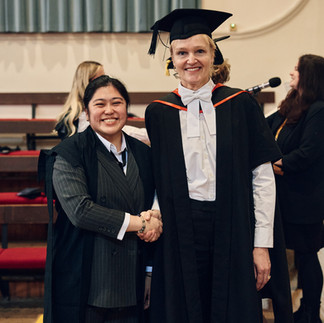


Note: On March 28, 2026, Anna Mae Yu Lamentillo delivered a speech at the final ceremony for the MSc in Major Programme Management cohort at Saïd Business School, University of Oxford, hosted at the Holywell Music Room. The contents of this speech are released under a Creative Commons Attribution (CC BY 4.0) license. Feel free to reuse or distribute with attribution.